Est. 2018
Family owned in Edmond, serving the OKC metro
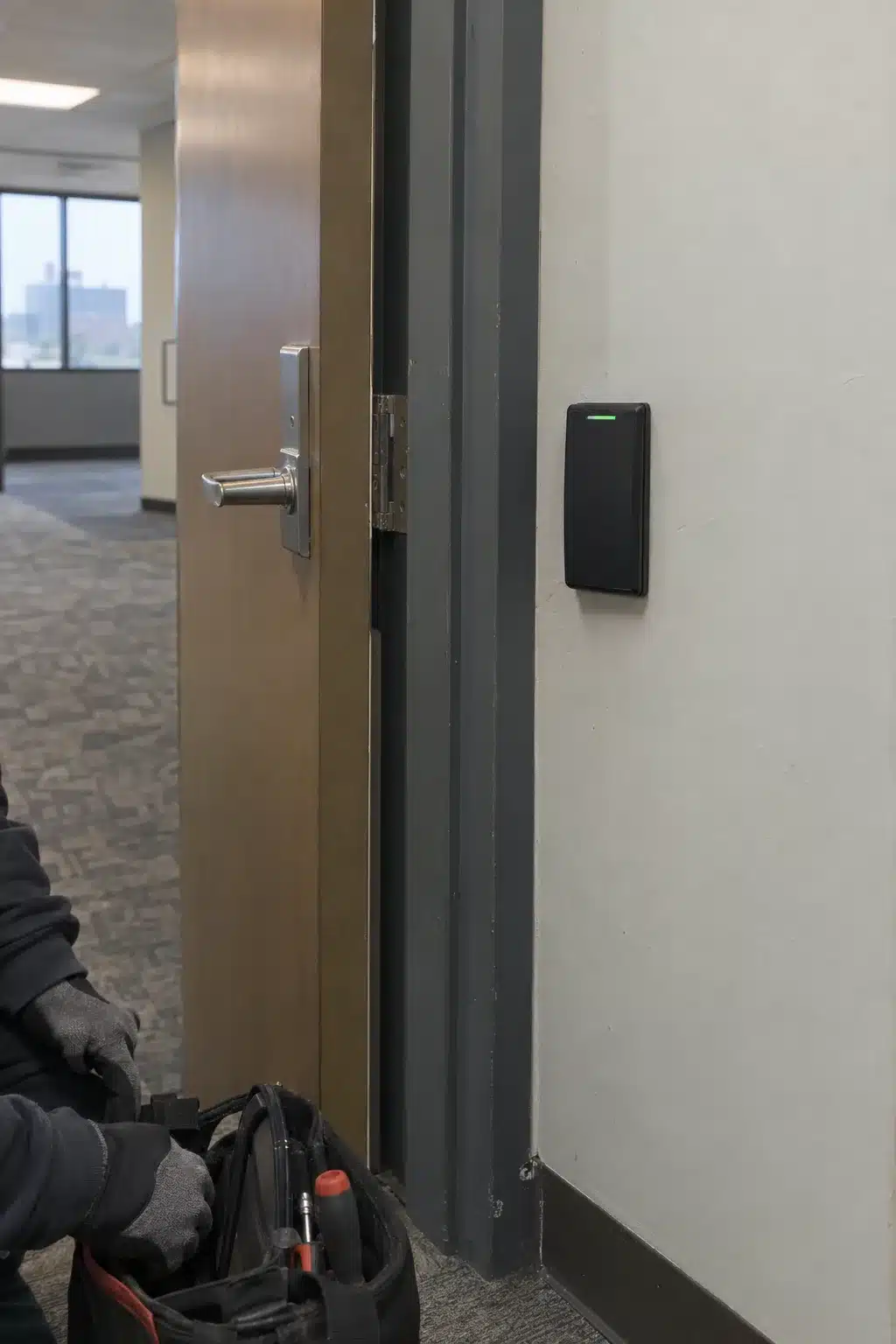
Most single-door access control jobs in Oklahoma City take 2 to 4 hours. Multi-door commercial systems run 1 to 2 days. The price quoted on the phone is the price on the invoice. No surprise fees.
Learn more about access control systems in Oklahoma City →
Available 6am - 9pm, 7 days a week. Owner-operated. One person accountable.
The honest answer is: it depends on the door, the hardware, and the building. A single keypad or card reader on a hollow metal commercial door with existing wiring runs 2 to 3 hours start to finish. A retrofit on a glass storefront door with no conduit and a new electric strike requires more time - closer to 4 to 5 hours for one door.
Learn more about car lockout Oklahoma City in Edmond, OK
Multi-door systems add time proportionally, but not always linearly. If the doors are close together and wiring runs through the same conduit path, doors 2 and 3 go faster than door 1. If each door is in a different area of the building with separate wire runs, you are looking at a full day or more for 3 to 5 doors.
The biggest variable most people do not think about is the door hardware itself. Access control installation in Oklahoma City on a door that already has a proper frame, a solid strike pocket, and conduit roughed in goes fast. A wood-framed interior door that needs a new electric strike mortised in, a surface-mount reader, and new wire run through finished walls is a half-day job by itself.
Before I quote a timeframe, I need to know: type of door (hollow metal, aluminum storefront, wood), whether you want a keypad, card reader, or fob reader, whether the door already has an electric strike or magnetic lock, and how far the wire needs to run to the power supply or control panel.
Oklahoma has no state licensing board specifically for locksmiths. That means any person can show up with tools and call themselves a professional. CNR Locksmith holds license A465149 and operates as a single-owner business where one person handles every job. Read more about what Oklahoma's lack of licensing law means for you.
The Associated Locksmiths of America (ALOA) publishes standards for professional access control practice. Learn more at aloa.org.
Understanding each phase helps you plan your schedule and know what questions to ask before work starts.
Every installation starts with looking at what you actually have. I check the door frame construction, the existing latch or lock hardware, whether the door swings in or out, and what kind of closer or hinge situation you are dealing with. An outswing door needs a different electric strike configuration than an inswing door. Getting this wrong means the door either does not lock properly or the strike fails within months.
I also check where power is available and how wire will run to the reader or keypad. In finished commercial spaces, wire often needs to run through existing conduit or be surface-mounted in raceway. That routing decision affects the total job time more than the hardware installation itself.
Mortising an electric strike, drilling for a magnetic lock bracket, or prepping a door frame for a surface-mount reader takes 30 to 60 minutes depending on door material and what needs to be cut or modified. Steel doors take longer to drill than aluminum.
Access control readers and electric strikes run on low-voltage wire, typically 18-gauge. The wire needs to reach from the reader at the door to the power supply and control board, which is usually mounted in a back room, server closet, or electrical panel area.
Wire runs in finished buildings are the most time-consuming part of the job. A 50-foot run through open ceiling tile takes 20 minutes. The same run through a finished drywall ceiling can take 90 minutes or more if there are fire-rated barriers to work around.
The control panel or standalone controller gets mounted, wired to the power supply, and connected to the reader and strike or magloc. Most standalone keypad systems use a simple two-board setup that takes 20 to 30 minutes to connect. Networked systems with software take longer because the controller also needs to be configured for your network.
Battery backup is worth adding at this stage. A power outage should not leave your building unsecured or your staff locked out. Most access control power supplies have a battery backup input - it is a small cost to add during installation and much harder to retrofit later.
For a standalone keypad system, programming means entering the access codes, setting the door release time (how long the strike stays unlocked after entry), and testing every code. For a card or fob system, each credential gets enrolled. This phase runs 20 to 45 minutes for a basic single-door setup.
I test the door with power on and with power off before I leave. Fail-safe vs. fail-secure behavior matters - a fail-safe lock releases on power loss, which is required on fire egress doors. A fail-secure lock stays locked on power loss, which is the right choice for a server room. That decision needs to be made before installation, not after. See panic bar requirements for Oklahoma City commercial properties.
The reader type does not change installation time significantly - the wiring and door hardware work is the same regardless. What changes the timeline is whether the system is standalone or networked. A standalone keypad programs in minutes. A networked card access system with software, a server, and multiple credential levels can take an additional 1 to 2 hours just for system configuration.
Fob systems using RFID cards or key fobs (125 kHz or 13.56 MHz Mifare) are common for small Oklahoma City businesses. Programming each fob takes about 30 seconds per credential once the system is set up. If you have 20 employees, plan on 15 to 20 extra minutes for credential enrollment.
For a full comparison of card, fob, and keypad entry options, see the access control systems guide for Oklahoma City.
A two-door system where both doors are near each other typically takes 5 to 7 hours. A four-door system spread across a building can easily be a full day, especially if wire has to run through multiple rooms or fire-rated walls.
Planning the wire routes before installation day saves real time. If I know the building layout in advance, I can bring the right conduit, raceway, and wire lengths. Showing up without a plan and figuring it out on site adds 30 to 60 minutes per door.
For businesses also managing exit compliance, see panic bar and exit device installation for Oklahoma City commercial properties.
Retrofit installations in occupied buildings almost always take longer than new construction. In a new build, conduit is roughed in before drywall goes up and you can run wire freely. In an existing office, you work around finished ceilings, occupied spaces, and whatever conduit was or was not planned originally.
The most common retrofit scenario in Oklahoma City is a small business that has been running on a keyed lock and wants to switch to card access after an employee turnover problem. That single-door retrofit - removing the existing lock, mortising an electric strike, mounting a reader, running wire to a controller in the back room - is the 2 to 4 hour job described above.
The ANSI/BHMA standards for access control hardware set minimum grade requirements for door components used in commercial applications. Learn more at bhma.org.
Full breakdown of card, fob, and keypad entry options for Oklahoma City businesses. Access Control Systems Oklahoma City.
Keypad and app-based locks are a simpler option for lower-traffic doors. Smart lock installation in Oklahoma City covers the options and trade-offs.
Not every lock situation needs a professional. Some access control jobs definitely do. See the full guide on when you need a licensed locksmith in OKC.
Straight answers to the questions people ask before booking an installation.
Have a question not covered here? Visit the full CNR Locksmith FAQ page or contact us directly.
Available 6am - 9pm, seven days a week.
Plan for 2 to 4 hours for a typical single-door installation. That covers assessment, hardware prep, wiring, controller setup, and testing. If the door has existing conduit and a pre-cut strike pocket, you can hit the low end. If it is a retrofit on a finished wall with no conduit, budget for the high end or slightly beyond. I will tell you which situation you are in before I start the clock.
Yes, but the hardware options are more limited. Glass doors typically use surface-mount magnetic locks (maglocks) on the door frame rather than electric strikes mortised into the door edge. The maglock mounts to the door header, and a matching armature plate mounts on the door itself. Installation on an aluminum storefront frame is straightforward once the wire route is determined. Figure 3 to 5 hours for a glass door with no existing wiring.
Access control runs on low-voltage power - typically 12V or 24V DC from a dedicated power supply. That power supply plugs into a standard 120V outlet. The low-voltage wiring from the power supply to the door hardware does not require a licensed electrician in most jurisdictions. If you need a new 120V outlet added near the control panel location, that portion of the work requires an electrician. I will tell you upfront if your installation needs one.
That depends on whether the system is fail-safe or fail-secure, and you choose that before installation. Fail-safe hardware releases (unlocks) on power loss - required on fire egress doors by Oklahoma fire code. Fail-secure hardware stays locked on power loss - appropriate for server rooms or storage areas where security outweighs immediate access. Battery backup on the power supply keeps either mode working through short outages. This decision needs to be made at the planning stage, not after the hardware is in.
Hardware costs and labor vary widely by system type and door count. A standalone keypad and electric strike for one door is significantly less than a networked multi-door card access system with software. I give a firm quote that covers hardware and labor before any work starts. The number on the phone is the number on the invoice. For a general sense of locksmith pricing in the OKC area, see the transparent cost breakdown for OKC locksmith services.
Sometimes. If the existing deadbolt is a quality unit and the door frame is solid, there are electrified deadbolt options and add-on electric strikes that work with existing hardware. More often, retrofitting access control means replacing the mechanical lock with an electric strike or maglock that the access control system controls directly. See deadbolt installation in Oklahoma City for context on when mechanical hardware makes more sense than electrified options.
Tell me the number of doors, door type, and your building address. I will give you a firm quote on the timeline and price before scheduling. No surprises. License A465149.
Available 6am - 9pm, 7 days a week. Owner-operated. One person, one invoice, no bait-and-switch.
© 2026 CNR Locksmith. Oklahoma City, OK. License A465149.
Written by Eran Bar-Yamin, Owner & Licensed Locksmith
CNR Locksmith, Oklahoma City & Surrounding Communities
